


Wowza Streaming Engine
Own your streaming infrastructure, extend every layer, and keep costs under control.
Wowza Streaming Engine is video streaming server software that ingests live and file-based video, transcodes it, and delivers it over standard protocols to any device. It installs on hardware you control and is fully extensible.
Wowza Streaming Engine:
- Can be deployed on-prem, in the cloud, at the edge, or air-gapped
- Includes DRM integration, watermarking, and encryption in every license, with no paid add-ons
- Extends through REST and Java APIs, plus a library of open-source modules
- Is an award-winning leader in video streaming, backed by 20+ years in production
Contact an expert to get a custom demo today, or dive into our documentation to see how you can build with Wowza.
Contact an expert
Extensible & Configurable
Streaming infrastructure you configure and control.
Provision applications, add stream targets, and pull live stream statistics from your own tooling, using the Wowza Streaming Engine Manager or the REST API.









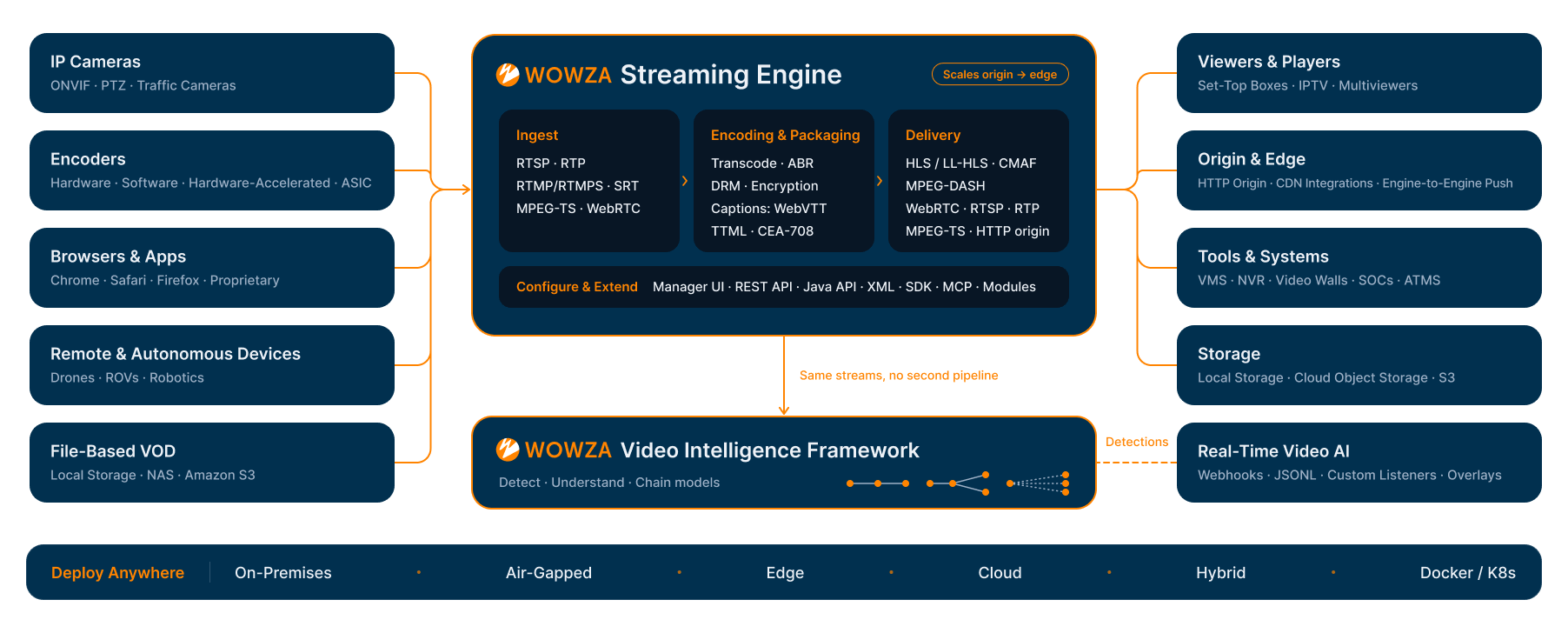
Wowza Streaming Engine handles all streams, across all devices.
Wowza Streaming Engine is a configurable video streaming server that handles live, real-time, and VOD workflows from a single server to a full fleet, and connects to the CDN of your choice for global reach. It gives engineering teams direct control over how video gets ingested, secured, processed, and delivered.
Wowza holds a SOC 2 Type II report from an independent CPA firm, as well as an ISO/IEC 27001:2022 certification, for organizations in sensitive industries.
Developer interfaces
Configure it. Automate it. Extend it.
Every layer of Wowza Streaming Engine is reachable from code.
The REST API creates and configures applications, manages stream sources and stream targets, and returns live server and stream statistics over HTTP or HTTPS. It is language-agnostic and publishes an OpenAPI specification that imports into Postman.
Read our REST API docs →The Java API supports custom modules, event listeners, and HTTP providers that run inside the server. Add authentication logic, stream handling, metadata injection, and workflow triggers.
Read our Java API docs →Server, virtual host, and application settings live in XML configuration files that version-control cleanly and deploy through your existing automation.
Read our XML configuration reference doc →A library of pre-built and custom modules extends Wowza Streaming Engine’s behavior without forking the product, from automated captions to programmatic live stream creation.
Read our Java Modules docs →Awards and recognition
Wowza Streaming Engine has been named the #1 live stream choice for enterprise organizations, along with dozens of other awards dating back to 2008.

Request a demo
Why teams choose it
Built for teams who run their own infrastructure.
Accelerate Time To Live
Install and get a stream running in minutes.
- Stand up a complete media server on your own hardware (AMD64, or ARM64 on Linux) in minutes
- Create applications, connect sources, and test playback in a browser-based interface
- Guided installers for Linux and Windows are ready to configure
- Package low-latency HLS, MPEG-DASH, CMAF, and WebRTC (WHIP and WHEP) from a single deployment
- Record live streams to MP4 and let viewers pause and rewind live streams with Wowza nDVR
- Configurable STUN and TURN, with OBS Studio, FFmpeg, and GStreamer interoperability
- Publish and play from standards-based WHIP and WHEP clients, with no proprietary SDK required
Control Your Deployment
Run your video workflows wherever you choose.
- Run Wowza Streaming Engine on-premises, on bare metal or virtual machines inside your network, at the edge, or fully offline and air-gapped
- Use pre-tuned machine images on AWS, Azure, and Google Cloud, directly or through marketplace offerings, for cloud deployments
- Container deployments run under Docker or Kubernetes, including GPU passthrough for hardware-accelerated transcoding
- Support SSL/TLS, token-based playback protection, IP allowlisting, and per-application authentication
- Integrate with commercial DRM providers
Build Custom Workflows
Integrate the media server with your existing stack.
- Integrate Wowza Streaming Engine with your existing encoders, storage, players, analytics, and monetization systems
- Build custom modules, develop event listeners, provision applications, and analyze streams using the REST & Java APIs and XML configuration files
- Use and customize open-source modules for workflows like automated captions and programmatic live stream scheduling
- Trust a company with an independent SOC 2 Type II report and ISO/IEC 27001:2022 certification

Control Your Costs
Build predictability into your technology budgets.
- Use your own hardware and resources with self-hosted deployments
- Spend engineering time on your product instead of assembling and maintaining separate tools for transcoding, packaging, recording, and security
- Develop pricing forecasts with predictable, instance-based pricing
- Integrate with DRM, watermarking, encryption, and a full module library, no paid add-ons
- Avoid egress charges on video that never needs to leave the network
- Keep costs tied to your own infrastructure, not to viewers, outputs, or hours streamed
- Scale transcoding and delivery through origin-edge architecture, so the expensive work only happens once
- Increase channel density per server with hardware-accelerated transcoding through NVIDIA NVENC, AMD Xilinx, Intel Quick Sync, and NETINT Quadra

Develop Intelligent Automation
Future-proof your pipeline without rebuilding it.
- Add real-time AI analysis to live streams with the Wowza Video Intelligence Framework (VIF)®
- Run motion detection, object detection, synthetic video detection, and VLM analysis without impacting stream uptime
- Deliver results as structured ID3 metadata, webhooks, burned-in overlays, custom listeners, and JSONL logs
Quickstart path
From download to first stream in minutes.
- 1Installation guide →
Install Wowza Streaming Engine
Run the guided installer on 64-bit Linux or Windows, or pull the Docker image. The installer includes the required Java runtime.
- 2REST API reference →
Create a live application
Wowza Streaming Engine comes with a live application out-of-the-box, configurable via the Wowza Streaming Engine Manager or through the REST API.
- 3Protocols and formats supported →
Connect any source
Publish from an encoder, camera, or browser using RTMP, RTSP, SRT, MPEG-TS, or WebRTC.
- 4Scaling guide →
Play back and scale
Test playback over HLS, MPEG-DASH, or WebRTC, then add edge servers, load balancing, or a CDN as needed.
Deployment
Deploy Wowza Streaming Engine where your video already lives.
Wowza Streaming Engine is built for teams who want full control over where their workflows run and where the data lives. No vendor lock-in and no forced migrations.
Specifications
Protocol, codec, and platform support specifications
Supported ingest and contribution protocols
Supported delivery protocols
Supported codecs & file formats
Hardware-accelerated transcoding
Operating systems & chipsets
Running statewide video infrastructure on Wowza Streaming Engine
From statewide traffic networks to mission-critical operations, teams rely on Wowza to deliver video at scale.
“With Wowza, servers became appliances. We script, provision, move, and rebuild cameras through the API, keep our video walls fed, and let operators focus on incidents instead of plumbing.”
What media server software works best for multi-device video delivery?
The best media server software for multi-device video delivery is one that packages a single ingest into any format your audience’s devices need. Wowza Streaming Engine ingests RTMP, RTMPS, SRT, RTSP/RTP, MPEG-TS, and WebRTC, then can deliver that same stream as HLS and Low-Latency HLS to iOS, Safari, and Roku; MPEG-DASH to Android and HTML5 players; CMAF for efficient HLS and DASH packaging; WebRTC to Chrome, Edge, Firefox, and Safari; MPEG-TS to IPTV set-top boxes; and RTSP/RTP to 3GPP devices, QuickTime, and VLC. One contribution feed fans out to every screen, without a separate encode. Adaptive bitrate packaging adjusts quality to each viewer’s bandwidth, and the server can run on-premises, in your cloud, at the edge, or fully air-gapped, so multi-device video delivery never requires giving up control of the infrastructure.
What is a video streaming server?
A video streaming server is software that ingests live or file-based video, processes it through transcoding and adaptive bitrate packaging, and delivers it to viewers over standard protocols like HLS, DASH, WebRTC, RTMP, and SRT. It sits between the video source and the viewer, handling the technical work of making video available at scale across devices, network conditions, and geographic regions. Wowza Streaming Engine is an award-winning, configurable, reliable video streaming server that gives organizations complete control over how video is ingested, secured, processed, and delivered.
What is a streaming media server?
A streaming media server is software that delivers audio and video to end users in real time or on demand. Unlike a standard web server, a streaming media server delivers media continuously and adjusts quality to available bandwidth. It handles protocol conversion, adaptive bitrate packaging, session management, and stream security.
Which streaming server is best for video streaming?
The best streaming server depends on deployment requirements, and Wowza Streaming Engine is the strongest choice for organizations that need production-grade reliability, deployment flexibility, and control. With 20+ years in production, it supports every major streaming protocol and can be run on-premises, in private clouds, in public clouds, and in air-gapped environments.
Can I build my own media server?
Building a media server from scratch is possible, but it requires significant engineering investment. A production-ready media server typically takes months and multiple engineers to build because it needs to cover protocols, transcoding, adaptive bitrate packaging, latency tuning, failover logic, security hardening, and ongoing maintenance. Embedding Wowza Streaming Engine is a faster and more reliable path because it can be deployed quickly and is fully extensible, giving your team the control of a self-built solution without the build cost or maintenance burden.
Do I need a video media server?
A video media server makes sense when a workflow demands ownership of infrastructure, custom logic, or latency and security requirements that packaged platforms cannot support. Firewalled and offline deployments, API-driven automation, and custom module development all necessitate a self-hosted media server, and Wowza Streaming Engine covers those cases at scale.
Should I create my own streaming service?
If compliance, brand control, monetization, flexibility, or unique viewer experiences matter, you should build a self-hosted streaming video solution. With Wowza, you control ingest, processing, and delivery, and can pair it with your preferred CDN, player, and analytics to assemble a fully self-hosted streaming service.
Which platform is best for video streaming?
For turnkey broadcasting to public audiences, social platforms usually suffice. For professional, white-label, or secure experiences, especially when you need real-time interactions, hybrid/cloud control, or offline capability, an on-premises streaming video streaming server like Wowza Streaming Engine provides maximum flexibility and reliability.
What software do most streamers use?
Streamers often encode video with software applications like OBS, or hardware encoders, and then send RTMP/SRT/WebRTC into a media server or social platform. Wowza Streaming Engine accepts ingest from virtually any encoder and outputs to any screen using standard protocols, making it a fit for professional studios, events, and 24/7 channels.
What streaming protocols does Wowza Streaming Engine support?
Wowza Streaming Engine ingests RTMP, RTMPS, RTSP, RTP, SRT, MPEG-TS, and WebRTC, and delivers HLS, Low-Latency HLS, MPEG-DASH with CMAF, WebRTC, RTMP, RTSP, SRT, and MPEG-TS. Contribution and delivery are configured independently, so a single ingest can fan out to multiple delivery formats. For a full list of supported protocols and codecs, visit https://www.wowza.com/docs/understanding-protocols-and-formats-supported-by-wowza-streaming-engine.
Can I achieve sub-second or low-latency streaming with Wowza Streaming Engine?
Yes. WebRTC delivers sub-second latency for real-time and interactive use cases, SRT provides resilient low-latency contribution across unmanaged networks, and Low-Latency HLS and MPEG-DASH balance reduced latency with large-scale delivery. The right choice depends on whether a workflow prioritizes interactivity or reach.
Which streaming server is best?
Wowza Streaming Engine is the best streaming server for organizations that need production-grade reliability, deployment flexibility, multi-device video delivery, and deep extensibility. For teams evaluating streaming servers, the key criteria are protocol support, deployment flexibility, latency, and security. With over 20 years in production, Wowza Streaming Engine supports every major streaming protocol and runs on-premises, in the cloud, or in air-gapped environments.
Can I manage Wowza Streaming Engine programmatically?
Yes. The Wowza Streaming Engine REST API can provision applications, manage stream sources and targets, and return live statistics over HTTPS. The Wowza Streaming Engine Java API allows developers to build custom modules, event listeners, and HTTP providers that run inside the server. Teams can also configure the server with XML files that are version-controlled.
How do I scale from a single server to a global audience?
Scaling starts with one instance and grows through an origin-edge architecture. Wowza’s Live Stream Repeater distributes streams from origin servers to edge servers, the Dynamic Load Balancer routes viewers to less-loaded servers, and Media Cache serves content from central or network storage. Pairing edges with a CDN absorbs large audience surges.
Where can I deploy Wowza Streaming Engine?
Wowza Streaming Engine deploys on-premises on bare metal or virtual machines, in private cloud, in public cloud through pre-tuned machine images on AWS, Azure, and Google Cloud, in Docker and Kubernetes containers, at edge sites, and in fully air-gapped environments.
Can Wowza Streaming Engine run completely offline or air-gapped?
Yes, Wowza Streaming Engine can run with no outbound internet connectivity, which supports classified, regulated, and remote deployments.
How do I secure my streams?
Wowza Streaming Engine supports SSL/TLS for encrypted transport, SecureToken for challenge-and-response playback protection, IP allowlisting, and per-application authentication. Commercial DRM integrations cover PlayReady, Widevine, and FairPlay through partner providers, and AES-128 and CENC/CBCS encryption protect HLS, DASH, and CMAF delivery. Wowza is a SOC 2 Type II certified company.
Does Wowza Streaming Engine support live streaming and video on demand (VOD)?
Yes, Wowza Streaming Engine supports both live and VOD streaming. Wowza Streaming Engine delivers live channels, always-on streams, and video on-demand libraries from the same server, with adaptive bitrate delivery for web, mobile, and OTT players.
Can I integrate Wowza with my existing apps and workflow?
Absolutely. Wowza Streaming Engine includes comprehensive APIs/SDKs and a modular architecture, so you can extend functionality, automate workflows, and integrate with your encoders, storage, analytics, playback, and monetization tools.
What does it take to keep Wowza Streaming Engine up to date?
Maintenance and support plans make sure your Wowza Streaming Engine deployment is up to date. Since Wowza Streaming Engine 4.8, Wowza has patched more than 35 CVEs, added more than 30 net-new capabilities, and fixed more than 100 bugs.
How is Wowza Streaming Engine licensed?
Wowza Streaming Engine licensing options include monthly subscriptions, one-month keys for short-term needs or testing, annual enterprise agreements, and offline keys for disconnected or air-gapped deployments. Each instance includes up to 10 concurrent transcoded channels.
Can Wowza Streaming Engine analyze video with AI?
Yes. The Wowza Video Intelligence Framework (VIF) adds real-time AI analysis to streams already running in Wowza Streaming Engine. VIF runs alongside Wowza Streaming Engine on NVIDIA GPU hardware. Analysis stays inside the deployment without blocking the stream, so video and inference stays within infrastructure your organization controls while the stream stays live.
Support
Expert Help When You Need It
We’re successful when you’re successful. Wowza offers a wide range of resources to help customers start fast and scale big, from free walkthroughs to premium support.

pricing
Wowza Streaming Engine Pricing Plans
One Month of Streaming
$295

Occasional on-prem hosted streaming needs or unpredictable events and audiences
- Fully customizable streaming server software
- Up to 10 concurrent, transcoded channels
- Additional instances $295
Basic Monthly
$195

Ongoing on-prem hosted streaming needs with steady events and growing audiences
- Fully customizable streaming server software
- Up to 10 concurrent, transcoded channels
- Additional instances $195
Enterprise
Plans built for your needs

Large-scale, self-hosted streaming with unique requirements
- Annual plans and discounted rates available
- Hybrid cloud services including CDN, Flowplayer, and analytics
- Built for scale
- Offline keys available
- Professional services for highly customized deployments
Start building on your own infrastructure.
Install Wowza Streaming Engine, connect a source, and have a stream running today.